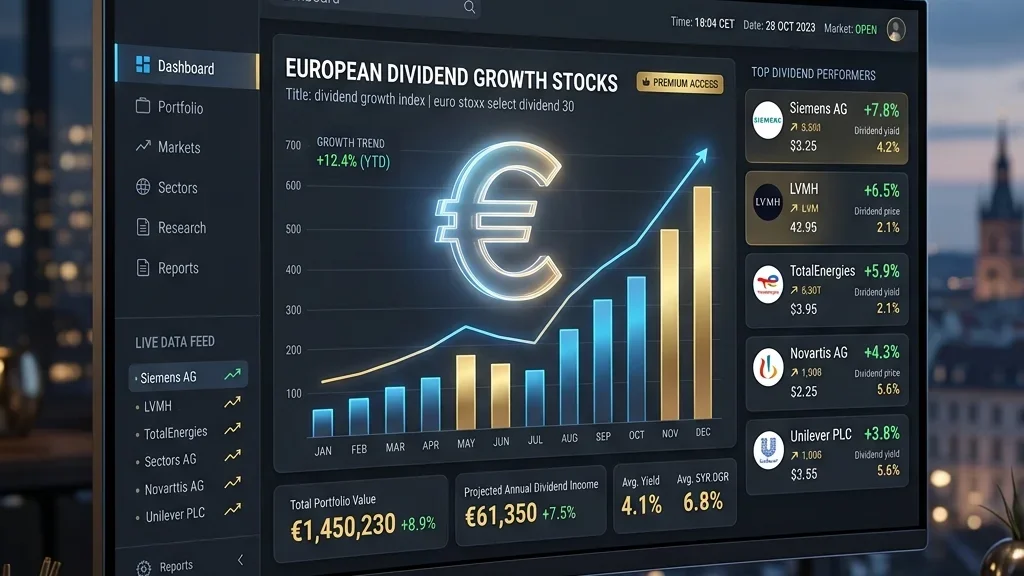
For the past decade, global stock market investing has been dominated by a single, overriding theme: the absolute supremacy of U.S. equities. Driven by the meteoric rise of the "Magnificent Seven" and the broader technology sector, the S&P 500 has consistently outperformed almost every other major geographic index. As we navigate 2026, however, smart wealth building demands that we examine the structural risks of this extreme concentration. Over 30% of the S&P 500’s total market capitalization is now concentrated in just a handful of technology firms. For investors seeking stable, passive income and geographical diversification, looking across the Atlantic to Europe is no longer just an alternative—it is a strategic necessity.
European equity markets offer a dramatically different landscape compared to their U.S. counterparts. Rather than relying on speculative growth and high valuation multiples, European companies historically place a much higher emphasis on returning capital to shareholders through consistent dividend payouts. However, building a successful dividend portfolio in Europe is not as simple as buying high-yielding stocks. The European Union is not a single tax jurisdiction; instead, it is a complex web of different national tax rules, withholding tax (WHT) rates, and double-taxation treaties (DTTs). In this comprehensive guide, we will break down how to construct a high-yield, tax-efficient European dividend portfolio in 2026, navigate the withholding tax minefield, and identify the top European dividend anchors for your wealth.
The Structural Appeal of European Dividend Stocks
In the United States, corporate culture heavily favors share buybacks as a method of returning value to shareholders. While buybacks are tax-efficient for investors in the accumulation phase, they do not provide the tangible, regular cash flow needed for passive income strategies. In contrast, European companies have a deeply rooted dividend culture. Many of Europe’s oldest and most stable enterprises operate in mature, cash-generative industries like consumer goods, financial services, healthcare, and industrial manufacturing. These sectors naturally lend themselves to steady dividend increases.
Furthermore, European stocks currently trade at a significant valuation discount compared to U.S. equities. In 2026, the cyclically adjusted price-to-earnings (CAPE) ratio of the S&P 500 remains elevated, while European indices like the Euro Stoxx 50 trade at far more reasonable valuations. By investing in European equities, you are effectively buying higher dividend yields per dollar (or euro) invested, while insulating your portfolio from the extreme valuation volatility of the U.S. tech sector.
Understanding the Withholding Tax (WHT) Minefield
The single greatest obstacle to maximizing your returns in European stocks is Withholding Tax (WHT). When a European corporation pays a dividend to a foreign shareholder, the tax authority in the company's home country automatically deducts a percentage of that dividend before it reaches your brokerage account. If you are not careful, this double taxation can erode your net yield by 15% to 35%.
Let’s examine the standard domestic dividend withholding tax rates for some of the major European economies in 2026:
| Country | Standard Domestic WHT Rate | Typical DTT Treaty Rate | Tax reclaim Complexity |
|---|---|---|---|
| Germany | 26.375% (incl. solidarity surcharge) | 15% | Medium-High (requires digital application) |
| France | 12.8% (for non-resident individuals) | 15% / 12.8% | Medium (often applied at source by major brokers) |
| Netherlands | 15% | 15% / 0% | Low (perfectly aligned with most global treaties) |
| Switzerland | 35% | 15% | High (tedious paper-based reclaim process) |
| United Kingdom | 0% | 0% | None (extremely tax-friendly for foreign investors) |
To avoid losing a third of your dividend income to foreign governments, you must utilize Double Taxation Treaties (DTTs). Most countries have bilateral tax treaties that limit the maximum withholding tax on dividends to 15% for individual investors. The difference between the standard rate and the treaty rate must either be reduced at source (by your broker) or reclaimed by you from the foreign tax authority.
How to Optimize Withholding Tax in Practice
To make your European dividend portfolio tax-efficient, follow these core principles:
- Choose the Right Broker: Not all brokers are created equal. Premium brokers like Interactive Brokers, Saxo Bank, or major domestic banks support tax relief at source for countries like France, the US, and the Netherlands. Discount brokers often charge high administrative fees for processing tax reclaims, making smaller positions unprofitable.
- Favor Tax-Friendly Jurisdictions: Focus your portfolio allocation on countries with low standard WHT rates or straightforward reclaim processes. The United Kingdom (0% WHT) and the Netherlands (15% WHT, easily credited against domestic tax in most countries) should form the bedrock of your European dividend allocation.
- Avoid High-WHT Jurisdictions for Small Positions: Unless you are investing significant capital, avoid countries like Switzerland (35% WHT) or Italy (26% WHT) where the cost and bureaucratic hassle of reclaiming the excess tax outweigh the dividend payouts.
UCITS vs. US-Domiciled ETFs: The EU Investor Perspective
If you are an EU-based investor, the regulatory framework of MiFID II prevents you from buying US-domiciled ETFs directly. Instead, you must use UCITS ETFs (Undertakings for Collective Investment in Transferable Securities). When choosing a European dividend ETF, you face another tax decision: Distributing vs. Accumulating, and the ETF's physical domicile.
For maximum tax efficiency, European dividend ETFs should be domiciled in **Ireland** or **Luxembourg**. Ireland is particularly favored because it has a highly beneficial tax treaty network. For instance, Irish-domiciled ETFs pay only 15% withholding tax on U.S. stock dividends, whereas Luxembourg-domiciled ETFs pay 30%. When it comes to European equities, Irish UCITS ETFs also benefit from excellent treaty rates, passing on the maximum possible yield to the investor.
Top 5 European Dividend Anchors for 2026
To give your portfolio a strong foundation, here are five blue-chip European companies that combine robust structural moats, strong balance sheets, and a proven commitment to growing their dividends in 2026:
1. ASML Holding N.V. (Netherlands) - The Tech Monopoly
While tech is not traditionally seen as a dividend sector, ASML is an exception. As the sole manufacturer of Extreme Ultraviolet (EUV) lithography machines required for advanced semiconductor manufacturing, ASML holds a virtual monopoly on the global chip supply chain. While its yield is relatively low (typically around 1.2% to 1.8%), its dividend growth rate is exceptional, backed by a massive order backlog stretching into the 2030s. Domiciled in the Netherlands, its 15% withholding tax is highly manageable.
2. Allianz SE (Germany) - The Insurance Powerhouse
Allianz is one of the largest financial services and asset management companies in the world. Insurance is a highly cash-generative business, and Allianz has capitalized on this by offering a consistent dividend yield typically ranging between 5% and 6.5%. The company targets a 50% dividend payout ratio, adjusted for extraordinary items, and has a strong track record of progressive dividend increases, making it a classic passive income anchor.
3. Sanofi S.A. (France) - Defensive Healthcare
Healthcare is a defensive sector that performs well across all economic cycles. Sanofi, a French multinational pharmaceutical company, specializes in specialty care, vaccines, and general medicines. With a dividend yield consistently hovering around 3.5% to 4.5%, Sanofi has increased its annual dividend for nearly three consecutive decades. France's 12.8% withholding tax for non-residents makes Sanofi a highly tax-efficient holding for international investors.
4. Unilever PLC (United Kingdom) - Consumer Staples Resilience
Unilever owns over 400 brands, including household names like Dove, Knorr, and Hellmann’s. Consumer staples companies possess immense pricing power, allowing them to pass inflationary costs directly onto consumers. Unilever provides a stable 3.5% to 4% dividend yield. Because Unilever is domiciled in the United Kingdom, it pays out dividends with 0% foreign withholding tax, making it a highly efficient holding regardless of your brokerage quality.
5. LVMH Moët Hennessy Louis Vuitton (France) - Premium Luxury Moat
LVMH is the undisputed king of global luxury goods, boasting a portfolio of iconic brands like Louis Vuitton, Dior, and Moët & Chandon. The luxury sector enjoys incredibly high gross margins and price inelasticity. LVMH has consistently increased its dividend payout over the long term, supported by expanding global wealth. It offers a modest but highly secure yield of around 1.5% to 2%, with massive capital appreciation potential.
Step-by-Step Portfolio Construction
To assemble your portfolio, we recommend a core-satellite structure. The "Core" should consist of low-cost, physically replicated UCITS ETFs domiciled in Ireland, covering the broader European dividend market (such as the Vanguard FTSE Developed Europe UCITS ETF). This ensures broad diversification across 500+ European companies.
The "Satellite" portion should consist of 10 to 15 high-conviction individual stocks (like the five listed above) focused heavily on tax-friendly jurisdictions like the UK and the Netherlands. By keeping individual stock selections targeted, you limit the administrative burden of tax reclaiming while boosting your overall portfolio yield.
Conclusion
Diversification is the only free lunch in finance. In 2026, relying solely on U.S. index funds exposes your wealth to historic concentration and valuation risks. By expanding your horizons to include a structured, tax-optimized European dividend portfolio, you secure a reliable, growing stream of passive income. Keep withholding taxes low by selecting the right brokers and domiciles, focus on world-class businesses with wide economic moats, and let the compounding power of European dividends accelerate your path to location-independent financial freedom.
☕ Support Our Work
If you found this financial analysis valuable, you can support our independent research by sending a tip in USDT (TRC-20) to our secure cold storage address.