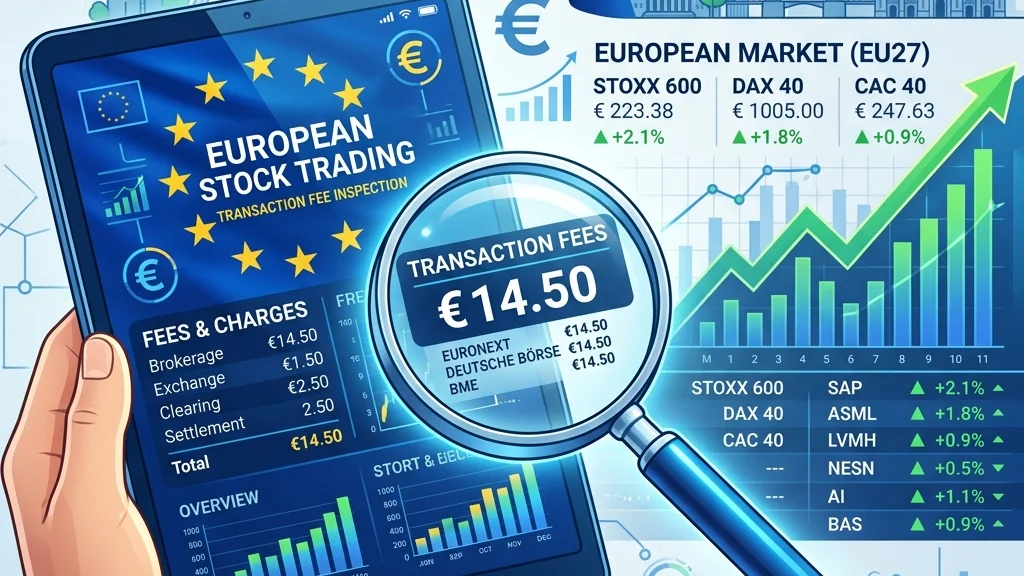
When retail stock investors evaluate the performance of their portfolios, they focus primarily on management fees (TER), brokerage commissions, and capital gains taxes. However, in Europe, a less visible but highly punitive cost exists: the Financial Transaction Tax (FTT). Enforced by several major European Union member states, the FTT levies a direct tax on the purchase of equity securities, acting as an immediate drag on investment returns.
In 2026, as European countries seek to balance their fiscal budgets, transaction taxes are being closely monitored and, in some cases, expanded. For retail investors looking to maximize their compound growth over a multi-decade horizon, understanding the rules of the FTT is critical for portfolio design. This guide analyzes how FTT operates in Europe and shares practical strategies to minimize its impact.
The Scope of FTT: Who Charges What?
Unlike standard VAT or capital gains taxes, the FTT is charged only on the **purchase** of shares, not the sale. It is applied based on the country where the issuing company is headquartered, regardless of where the investor resides or which broker they use. The major active FTT regimes in Europe include:
1. France (Taxe sur les Transactions Financières - TTF)
France levies a 0.30% tax on the purchase of shares of French companies with a market capitalization exceeding €1 billion. The tax applies to top corporations like LVMH, TotalEnergies, and Sanofi, regardless of whether you purchase them through a French broker or an international platform.
2. Spain (Impuesto sobre las Transacciones Financieras)
Spain enforces a 0.20% tax on the acquisition of shares of Spanish companies with a market capitalization of more than €1 billion. This includes major equities like Santander, BBVA, and Iberdrola.
3. Italy (Tobin Tax)
Italy levies a transaction tax ranging from 0.10% to 0.20% on shares of Italian companies with a market cap over €500 million. The exact rate depends on whether the transaction occurs on a regulated market (0.10%) or over-the-counter (0.20%).
How FTT Drags Down Portfolio Performance
At first glance, a tax rate of 0.20% or 0.30% seems negligible. However, for active investors or those executing regular dollar-cost averaging (DCA) strategies, the tax creates a significant drag.
If you invest €1,000 monthly into French equities, you pay €3 in tax every month. Over 30 years, that €36 annual drag, compounded at 8%, results in thousands of euros in lost wealth. Furthermore, if you trade frequently (swing trading or day trading), FTT can quickly make your strategy unprofitable, as it is levied on every single purchase order regardless of whether the trade ultimately makes a profit.
Broker Differences and FTT Compliance
Not all brokers handle FTT in the same way. High-quality international brokers (such as Interactive Brokers or DEGIRO) automatically calculate and display the FTT on your order confirmation screen, transferring the tax to the respective European tax authorities on your behalf.
However, some low-cost neobrokers hide this tax in their spread or fail to warn investors, leading to unexpected cash deductions from accounts. Always review your broker's fee schedule to ensure transparent FTT reporting.
Strategies to Optimize Transaction Costs
To protect your portfolio from transaction tax drag, consider the following optimization strategies:
1. Focus on Small and Mid-Cap Equities
FTT only applies to companies exceeding specific market capitalization thresholds (€1 billion in France and Spain, €500 million in Italy). Investing in high-quality small and mid-cap European companies is completely exempt from FTT, allowing your capital to compound without tax drag.
2. Utilize Broad Market ETFs
When you purchase an ETF (such as an MSCI Europe or Euro Stoxx 50 ETF), you are buying shares of the fund, not the underlying stocks directly. The purchase of the ETF shares by retail investors is exempt from FTT. While the ETF manager may pay FTT when they rebalance the fund's holdings, their economies of scale and low turnover minimize the net cost passed down to you.
3. Extend Your Holding Horizon
Since FTT is only charged upon purchase, the cost is amortized over the period you hold the asset. If you buy a stock and hold it for 20 years, a one-time 0.30% tax has an annual cost of just 0.015%. If you hold it for only 2 months, the annualized tax drag is 1.8%, illustrating why long-term investing is superior in FTT regimes.
Conclusion
European Financial Transaction Taxes are a structural friction that retail investors cannot ignore. By understanding the thresholds in France, Spain, and Italy, utilizing broad-market ETFs, and shifting to a long-term investment horizon, you can protect your portfolio from tax drag and optimize your path to financial freedom.