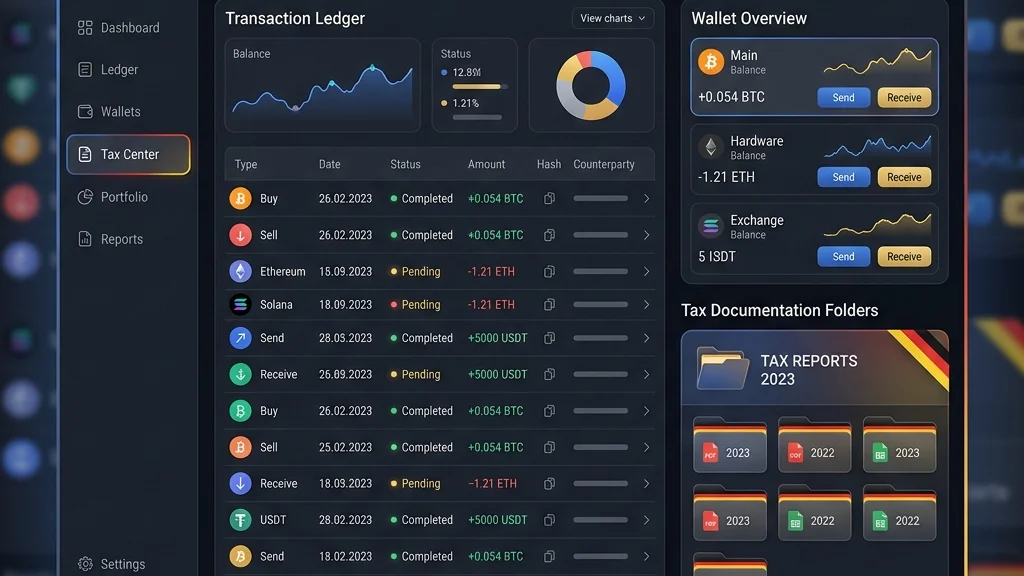
Introduction: The German 1-Year Crypto Holding Rule
Under Germany's income tax act (Einkommensteuergesetz - EStG), cryptocurrency is categorized as a private asset. This categorization grants a highly attractive tax benefit: if you hold a crypto-asset for more than one year before selling, trading, or spending it, any capital gains you realize are 100% tax-free. This stands in stark contrast to many other jurisdictions where crypto gains are taxed regardless of holding duration.
However, there is a catch. The burden of proof lies entirely on the taxpayer. If you claim that your crypto gains are tax-exempt because you held the assets for over 12 months, the German tax office (Finanzamt) will require concrete, verifiable proof. Without sufficient documentation, the Finanzamt will classify your gains as taxable private sales transactions (private Veräußerungsgeschäfte), subjecting them to your regular personal income tax rate (up to 45%). In this guide, we break down exactly how to document, calculate, and prove your 1-year holding period to ensure you secure your tax-free status.
The German Burden of Proof: What the Finanzamt Expects
Unlike traditional stock brokers who automatically compile tax certificates, crypto exchanges operate globally and do not report transactions to local tax offices in a standardized German format. When auditing your tax return, a German tax officer expects a complete, chronological audit trail. You must prove:
- The exact date and time the cryptocurrency was acquired.
- The purchase price in Euros at the time of acquisition.
- The exact date and time the cryptocurrency was sold, traded, or transferred.
- The sale price in Euros or the fair market value of the traded asset.
- That the specific coins or tokens sold were the ones held for more than 365 days.
How FIFO (First-In, First-Out) Determines Your Holding Period
To establish which coins you sold and how long you held them, German tax law utilizes the **FIFO (First-In, First-Out)** method as the default accounting standard. Under FIFO, the first coins you purchase are assumed to be the first coins you sell or trade.
For example, if you bought 1 BTC in January 2024 and another 1 BTC in June 2024, and then sold 1 BTC in February 2025: under FIFO, the BTC sold is considered to be the one purchased in January 2024. Since the holding period exceeds one year (January 2024 to February 2025), the capital gains on that sale are completely tax-free. Accurate FIFO tracking across multiple exchanges and wallets is critical to proving your holding periods.
Step-by-Step Guide to Gathering Your Tax Evidence
To prepare a bulletproof tax defense, you need to compile a comprehensive documentation package. Follow these three steps:
Step 1: Export Complete Exchange CSV Transaction Logs
Do not rely on simple screenshots of your exchange dashboards. You must export official CSV or Excel files containing your entire transaction history. This includes all buy orders, sell orders, deposit logs, and withdrawal records. Make sure to download these records annually, as some exchanges (like Binance or Coinbase) restrict search histories after a certain period or if an account becomes inactive.
Step 2: Document Self-Custody Transfers and Wallet Addresses
If you transferred your cryptocurrency from a centralized exchange to a hardware wallet (like Ledger or Trezor) for safe-keeping, you must document this transfer path. The Finanzamt might assume a transfer to a private wallet is a taxable sale unless you prove custody was maintained. Keep track of:
- The sending exchange withdrawal transaction hash (TxID).
- The receiving blockchain address of your hardware wallet.
- Proof of ownership of the hardware wallet (e.g., signing a message or showing continuous control).
Step 3: Track Staking, Lending, and Airdrop Lock-ups
It is important to note that participating in staking, lending, or liquidity pools can complicate your holding period tracking. Under previous guidelines, staking could extend the holding period to 10 years, but the German Federal Ministry of Finance (BMF) updated this in 2022: the holding period for staked crypto remains one year. However, the rewards themselves are taxable upon receipt, and their subsequent holding period starts from the day you received them. You must document the exact block time and value of every reward payout.
Using Specialized Crypto Tax Software
Manually calculating FIFO across dozens of transactions, gas fees, and wallet transfers is nearly impossible and highly error-prone. The most efficient way to prove your holding period is to use specialized crypto tax software that supports German tax laws (e.g., Koinly, CoinTracking, or Blockpit).
These platforms connect to your exchanges via read-only APIs or CSV imports, track your assets across all wallets, apply the FIFO method, and generate a standardized German Tax Report (Anlage SO). This report shows the tax-exempt gains separately from taxable gains, providing the exact transaction ledger the Finanzamt wants to see.
Conclusion: Stay Organized for Peace of Mind
Germany's tax-free rule for long-term crypto holders is one of the most generous in the world, but it requires diligent record-keeping. By maintaining organized CSV files, keeping wallet transfer hashes, and utilizing reputable crypto tax software, you can easily prove your holding periods and legally protect your wealth from unnecessary taxation. Start documenting your transactions today—your future tax-free gains depend on it.
Secure Your Assets with Ledger
Centralized exchanges and hot wallets are vulnerable to online threats. Keep your private keys physically isolated on a Ledger hardware wallet. Buy directly from the official store using our partner link to ensure device authenticity.
Get Your Ledger Securely →☕ Support Our Work
If you found this financial analysis valuable, you can support our independent research by sending a tip in USDT (TRC-20) to our secure cold storage address.