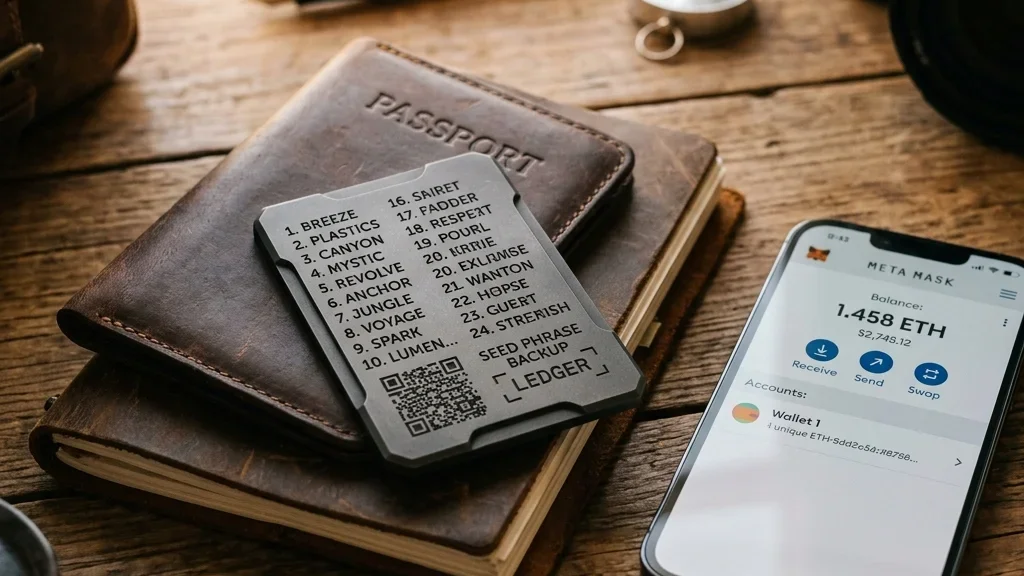
A masterclass in geographical redundancy, physical stealth, and border-crossing security for international Web3 investors.
1. The Nomad’s Paradox: Global Mobility vs. Custodial Vulnerability
In 2026, the dream of living as a location-independent digital nomad has merged with the massive growth of the Web3 economy.
A new class of global citizens earns, invests, and secures their net worth entirely on public blockchains.
However, this shift introduces a major security challenge: The Nomad’s Paradox.
How do you maintain absolute control over your digital wealth while physically moving across borders, checking into temporary rentals, and transiting through airports?
Traditional investors rely on local banks, safety deposit boxes, and physical property deeds tied to a single legal jurisdiction.
For a crypto investor, their entire net worth is ultimately protected by a single piece of cryptographic data: a 12- or 24-word seed phrase.
If you lose this phrase, or if it is stolen, your assets are gone forever. There is no customer support to call, and no government agency can reverse a blockchain transaction.
When you are constantly on the move, the threat landscape changes.
You face physical theft in transit, device seizures at border crossings, and the risk of leaving backups behind in short-term accommodations.
Securing your seed phrase while traveling requires moving away from basic backup habits and adopting a professional security model built on physical stealth and geographical redundancy.
2. Why Digital Storage is an Absolute Trap
The most common mistake travelers make is digitizing their seed phrase to make it easier to access.
When you are preparing for a flight, the convenience of saving a backup in a notes app or taking a photo of your recovery sheet is tempting.
However, this creates an immediate point of failure.
The Hidden Risks of Digital Backups
- Automated Cloud Synchronisation: The moment you take a photo or save a text file, your device likely uploads it to Apple iCloud, Google Drive, or Dropbox. If your cloud account is hacked, your seed phrase is compromised.
- Malware and Clipboard Hijackers: Modern mobile and desktop operating systems are constantly targeted by stealthy malware that looks for patterns matching 12- or 24-word seed lists in your clipboard or files.
- Border Device Seizures: Immigration officers in several countries have the legal authority to demand your phone or laptop password and run automated search scripts on your files. A PDF or image containing your seed phrase will be flagged instantly.
- Physical Device Loss: If your laptop or phone is stolen while you are on public Wi-Fi or in a transit hub, an experienced thief can extract local application data and photos, even on encrypted devices.
A seed phrase must exist only in the physical world.
It must never be typed into a keyboard, copied to a clipboard, photographed, or stored on any device connected to the internet.
3. The Art of Geographical Redundancy: Multi-Location and Split-Key Setups
If you keep your seed phrase on a single piece of paper or metal plate in your backpack, you are one bag theft away from financial disaster.
To secure your assets, you must implement geographical redundancy.
This means splitting your backup into parts that are useless on their own, and storing those parts in different geographical locations.
Shamir's Secret Sharing (SSS)
Shamir's Secret Sharing is a cryptographic formula that allows you to split a seed phrase into multiple unique shares.
You can set a threshold, such as a 2-of-3 or 3-of-5 setup.
For example, in a 2-of-3 split, you generate three separate shares. You need any two of them to reconstruct the original seed phrase. A single share reveals zero information about your keys.
| Share Location | Share A | Share B | Share C | Result if Compromised |
|---|---|---|---|---|
| Location 1: Safe Deposit Box (Home Country) | Stored Safely | - | - | Zero risk. Attacker has 1 of 3 shares. |
| Location 2: Trusted Family Member | - | Stored Safely | - | Zero risk. Attacker has 1 of 3 shares. |
| Location 3: Traveler's Physical Luggage | - | - | Stored Safely | Zero risk. Thief only gets 1 of 3 shares. |
If your luggage is stolen while you are traveling, the thief only gains access to Share C.
Because they do not have Share A or B, your funds remain secure.
Once you reach a safe location, you can retrieve your other shares to recover your wallet and move your funds to a new address.
Multi-Signature (Multisig) Setups
For larger portfolios, a multisig setup is more secure than splitting a single seed phrase.
Instead of one wallet with a split seed, you use multiple hardware wallets from different manufacturers, each with its own independent seed phrase.
To transfer funds, you must sign the transaction with a majority of the wallets (e.g., 2-of-3).
You can keep one wallet with you, store one in a secure location in your home country, and leave the third with a trusted custodian or partner.
Even if an attacker forces you to sign a transaction with the wallet in your pocket, they cannot steal your funds because they lack the second signature.
4. Physical Stealth: Conforming Metal Backups for Border Transit
Paper backups degrade quickly when exposed to humidity, water, or fire.
For long-term security, you should use metal backups made of marine-grade 316 stainless steel or titanium.
These metals can withstand temperatures over 1,400°C (2,500°F) and are immune to water damage.
However, carrying a heavy steel plate stamped with obvious words like "Bitcoin" or "Seed" through international borders is a major risk.
To travel safely, your physical backups must blend in with your everyday belongings.
Stealth Metal Backup Form Factors
- Credit Card Plates: Some manufacturers produce ultra-thin titanium cards that match the dimensions of a standard credit card. You can slip these into your wallet alongside your bank cards. An airport security scanner will see them as normal metal credit cards.
- Industrial Washers: A highly effective, low-cost method is stamping your seed phrase words (represented as BIP-39 numbers) onto industrial stainless steel washers. You then thread these washers onto a heavy-duty steel bolt. In a tool kit or luggage pocket, this looks like normal hardware store spare parts.
- Stealth Engraving: Avoid stamping full English words. Use the BIP-39 numerical representation instead. Every word in the BIP-39 wordlist corresponds to a number from 0001 to 2048. Stamping "0245 1890 0012" looks like serial numbers or manufacturing codes, which makes them meaningless to casual observers.
How to Pack Your Backups
Never pack all your backup materials in the same pocket or bag.
If you are carrying a split-key backup, keep one share in your wallet, pack one in your checked luggage, and leave one behind at your home base.
Ensure any metal plates are placed flat against the structure of your suitcase or backpack to prevent them from shifting and drawing attention during security scans.
5. Airport Security and Border Crossing Protocols
Border crossings are unique legal environments.
In most countries, traditional constitutional protections against search and seizure do not apply in the same way at an international border.
Customs officers can search your baggage, inspect your electronics, and ask detailed questions about your assets.
Your Legal Rights and Responsibilities
Most countries require you to declare physical currency or "monetary instruments" valued over $10,000.
Legally, holding a seed phrase in your head or carrying a key is not the same as carrying physical currency.
You are not carrying cash; you are carrying access keys to a global network.
However, if officers discover your hardware wallet or metal backup, they may ask you to explain it.
If they suspect you are carrying undeclared wealth, they can detain you or confiscate your devices for further analysis.
Border Transit Best Practices
- Use Air-Gapped Wallets: Air-gapped hardware wallets do not have USB ports or Bluetooth chips. They look like small calculators or simple security keys. This makes them less suspicious to border agents than devices that look like flash drives.
- Set Up a Duress PIN: Many modern hardware wallets allow you to configure a secondary PIN that opens a decoy account with a small amount of funds. If you are forced to unlock the device, enter the duress PIN to show a realistic but low-value wallet, keeping your main assets hidden.
- Do Not Lie to Officers: If specifically asked if you own cryptocurrency, answer truthfully but minimally. A simple "Yes, I hold some long-term digital investments" is better than lying and getting caught in a contradiction.
- Clear Your Devices Before Travel: Before flying, log out of cryptocurrency exchanges, Web3 browser extensions, and portfolio tracking apps on your phone and laptop. If your devices are inspected, there should be no obvious links to large crypto holdings.
6. Emergency Remote Recovery Protocols
What happens if you lose your hardware wallet while traveling, or if you are denied entry to a country where one of your backup shares is stored?
You need a clear Emergency Remote Recovery Blueprint.
This plan allows you to recover your assets from anywhere in the world without relying on a single physical location.
Setting Up an Off-Grid Recovery Protocol
First, ensure your recovery process does not rely on physical keys alone.
You can encrypt a backup of your seed phrase using strong encryption software like GnuPG (GPG) or VeraCrypt.
Use a long, complex passphrase that you have memorized and never written down.
You can upload this encrypted file to a public cloud account or save it on a USB drive.
Even if an attacker downloads the file, they cannot decrypt it without your memorized passphrase.
If you lose all your physical backups, you can download this encrypted file from any computer, decrypt it using your passphrase, and recover your wallet.
Second, implement a trusted contact emergency protocol.
Give one share of your split-key backup to a trusted family member or attorney.
Store this share in a sealed, tamper-evident envelope.
If you face an emergency, you can call them and ask them to open the envelope and read the share to you over a secure, encrypted voice call.
7. Physical Seed Phrase Backup Methods Comparison
Choosing the right backup method depends on your travel style and risk profile.
| Backup Method | Durability | Stealth Rating | Travel Suitability | Risk Profile |
|---|---|---|---|---|
| Paper Card | Low (Water, fire, wear) | High (Easy to hide) | Moderate (Short trips) | Single point of failure. Easy to destroy. |
| Metal Grid Plate | Very High (Fireproof, waterproof) | Low (Heavy, obvious) | Low (Attracts customs interest) | Highly secure but difficult to carry discreetly. |
| Stealth Credit Card Plate | Very High (Titanium) | Very High (Looks like credit card) | High (Fits in wallet) | Requires physical protection from scratch wear. |
| Shamir's Split (Metal) | Very High | High (Numerical only) | Very High (Nomad setups) | Requires setting up multiple secure locations. |
| Encrypted Digital File | Infinite (Cloud replication) | Absolute (Invisible) | Very High | High risk if your passphrase is weak or guessed. |
8. Step-by-Step Security Audit Checklist
Before you embark on your next international journey, perform this comprehensive security audit.
- [ ] Audit all digital footprints: Ensure no photos, screenshots, or unencrypted text files of your seed phrase exist on any of your devices or cloud accounts.
- [ ] Verify your backup integrity: Perform a recovery test on your hardware wallet to confirm your physical backups are 100% correct.
- [ ] Implement geographical redundancy: Split your backup using SSS or a multisig setup. Ensure no single location holds enough keys to access your funds.
- [ ] Transition to stealth metal: Replace obvious metal plates with credit-card-sized titanium cards or numerical BIP-39 stamped washers.
- [ ] Sanitize your devices: Uninstall exchange apps and log out of web wallets before arriving at airport security.
- [ ] Set up decoy accounts: Enable passphrases or duress PINs on your hardware wallets to protect against physical coercion.
- [ ] Establish an emergency recovery blueprint: Ensure you have a clear plan to access your funds if you lose your physical devices.
9. Conclusion: Control Your Assets Wherever You Go
True sovereignty means knowing that your wealth is secure, no matter which country you are in or what challenges you face during travel.
By moving away from risky digital backups and adopting geographical redundancy, physical stealth, and clear border transit protocols, you protect your assets from both online hackers and physical threats.
Do not let your travel lifestyle compromise your Web3 security.
Implement these professional storage strategies today, and travel with peace of mind knowing your wealth is safe.
Secure Your Assets with Ledger
Centralized exchanges and hot wallets are vulnerable to online threats. Keep your private keys physically isolated on a Ledger hardware wallet. Buy directly from the official store using our partner link to ensure device authenticity.
Get Your Ledger Securely →☕ Support Our Work
If you found this financial analysis valuable, you can support our independent research by sending a tip in USDT (TRC-20) to our secure cold storage address.