If you want to build long-term wealth in the stock market without spending hours analyzing individual balance sheets, listening to earnings calls, or reading financial charts, you are in the right place. Welcome to the golden era of passive investing. Over the past two decades, passive investing has grown from a niche academic theory into the dominant force in global stock markets, managing trillions of dollars for millions of smart investors.
At the center of this revolution are two extremely popular and highly efficient investment vehicles: Index Mutual Funds and Exchange-Traded Funds (ETFs). Both of these tools allow you to buy a basket of hundreds—or even thousands—of stocks in a single transaction, giving you instant diversification and highly stable, market-matching returns. Legendary investors like Warren Buffett have repeatedly stated that a low-cost S&P 500 index fund is the single best investment the average person can make.
Yet, while index funds and ETFs share the same underlying passive philosophy, they possess vastly different structures, costs, trading mechanics, and tax rules. Choosing the wrong vehicle for your specific budget, tax bracket, and trading style can cost you thousands of dollars in unnecessary fees and drag down your long-term compound growth. In this comprehensive, non-cannibalizing passive investing guide for 2026, we will break down the mechanics of both instruments, analyze their key differences, and help you select the absolute best wealth-building strategy for your unique financial goals.
What is an Index Mutual Fund?
To understand index funds, we must look to the pioneering work of John "Jack" Bogle, the legendary founder of Vanguard, who launched the first retail index mutual fund in 1976. Bogle''s philosophy was simple yet revolutionary: instead of paying expensive Wall Street fund managers to "beat the market" (which 90% of them fail to do over a 15-year period), why not simply buy the entire market?
An index mutual fund is a pooled investment vehicle that aims to track the performance of a specific financial index, such as the S&P 500, the Nasdaq 100, or the Russell 2000. When you invest $1,000 into an S&P 500 index fund, your money is pooled with millions of other investors. The fund''s computer algorithms then buy shares of all 500 companies (Apple, Microsoft, Amazon, Tesla, etc.) in exact proportion to their market capitalization.
Key characteristics of index mutual funds include:
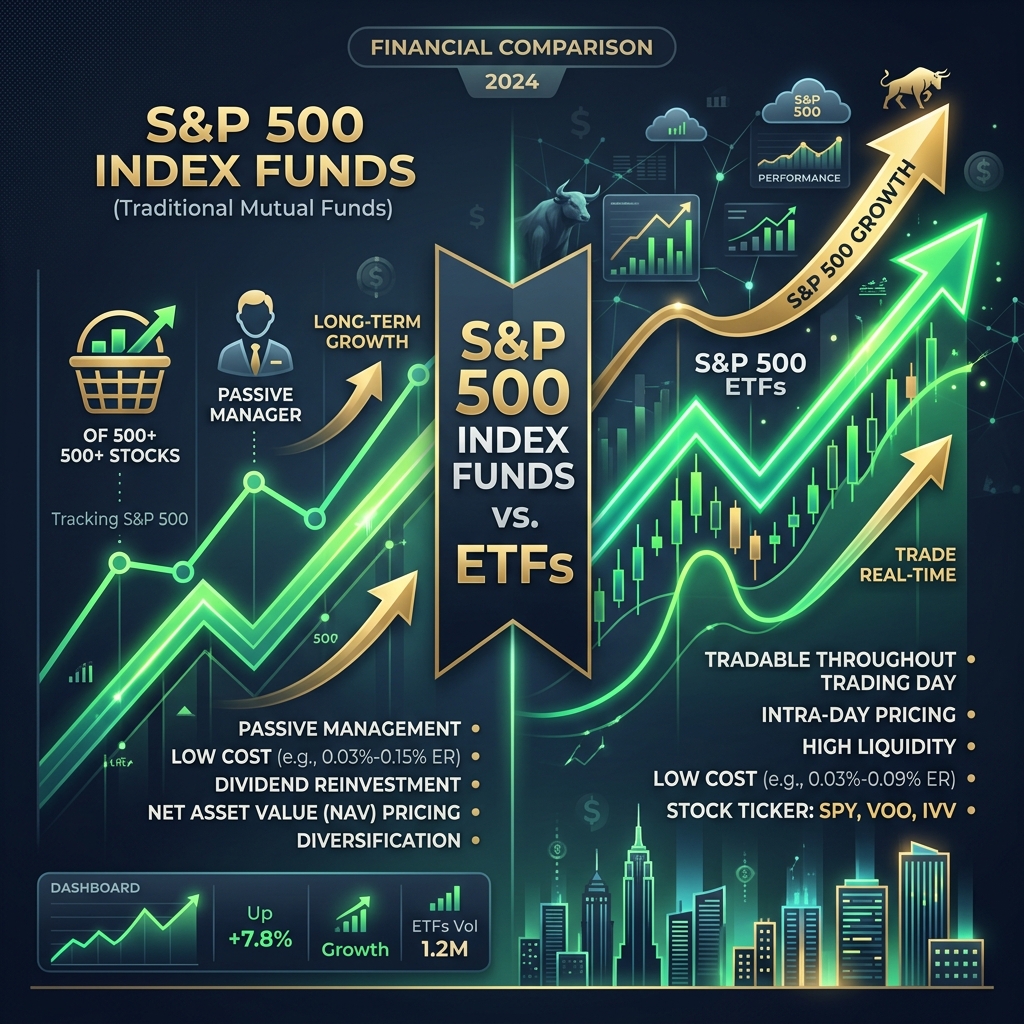
- End-of-Day Pricing: Unlike stocks, index mutual funds only trade once per day after the market closes (at 4:00 PM EST). No matter what time you place your order during the day, your transaction is executed at the final Net Asset Value (NAV) price.
- Direct Fund Transactions: You buy and redeem shares directly from the fund company (e.g., Vanguard, Fidelity, Schwab), not from other investors on an exchange.
- Fractional Share Ease: Because transactions are dollar-based, you can invest any exact amount (e.g., $15.50) and buy precise fractional shares automatically.
What is an Exchange-Traded Fund (ETF)?
While index funds dominated the late 20th century, a new challenger emerged in 1993 with the launch of the SPDR S&P 500 ETF (SPY), the first exchange-traded fund. ETFs took the core concept of an index fund—buying a diversified basket of stocks—and packaged it inside a vehicle that could be traded on the open market like a regular stock.
When you buy an ETF, you are buying shares of a fund that holds the underlying assets. However, instead of buying directly from the fund company, you buy those shares from other market participants on a secondary stock exchange (like the NYSE or Nasdaq) through your brokerage account.
Key characteristics of ETFs include:
- Intraday Liquidity: ETFs trade continuously throughout the trading day. You can buy, sell, short, or place limit orders on an ETF at any second, with prices fluctuating in real-time based on supply and demand.
- Market-Driven Pricing: The price you pay is determined by the market bid-ask spread. While specialized mechanisms ensure the ETF price stays very close to the actual value of the underlying stocks, minor premiums or discounts can occur.
- No Investment Minimums: You can start investing in an ETF with as little as the price of a single share (or even less if your broker supports fractional ETF trading).
Key Differences: Index Funds vs. ETFs
To choose the best vehicle for your portfolio, we must compare their primary features across five critical dimensions:
1. Minimum Investment Requirements
For beginners with a small budget, ETFs are the undisputed winner. Most premium index mutual funds require a minimum initial investment. For example, Vanguard''s famous S&P 500 index fund (VFIAX) requires a minimum of $3,000 to get started. While Schwab and Fidelity offer index funds with no minimums, Vanguard remains the gold standard, making their ETFs highly attractive. Because ETFs trade like stocks, your minimum investment is simply the market price of a single share (often between $50 and $450), or even $1 if your broker supports fractional shares.
2. Tax Efficiency (The In-Kind Creation/Redemption Miracle)
For taxable brokerage accounts, ETFs possess a massive, structural tax advantage. When investors sell shares of an index mutual fund, the fund manager must frequently sell the actual underlying stocks to generate cash to pay out the departing investors. This sale triggers capital gains taxes, which are distributed to all shareholders at the end of the year—even if you held your shares and didn''t sell a dime! This is known as a phantom tax drag.
ETFs, however, utilize a highly sophisticated "in-kind" creation and redemption mechanism managed by Institutional Authorized Participants (APs). When ETF shares are redeemed, the assets are swapped "in-kind" without triggering a taxable event. This means ETFs rarely distribute capital gains, allowing your wealth to compound 100% tax-free until you decide to sell your position.
3. Automatic Investing and Dollar-Cost Averaging
If your strategy is to set up automated monthly transfers from your bank account to automatically buy S&P 500 assets on autopilot, index mutual funds are historically superior. Because they are direct dollar-based transactions, you can easily configure your broker to automatically transfer $200 every Friday and buy $200 worth of the index fund. With ETFs, while many modern brokers (like Robinhood, M1 Finance, or Fidelity) now support automated fractional ETF purchases, older and traditional brokerages still require you to log in manually and execute a buy order during market hours.
4. Expense Ratios and Transaction Costs
Both index funds and ETFs are incredibly cheap compared to active mutual funds (which often charge 1.00% to 1.50% annually). However, we must watch the small details. The internal management fee of a fund is called the **expense ratio**. For passive funds, these fees are tiny. For example, the Vanguard S&P 500 ETF (VOO) has an expense ratio of just 0.03%. This means you pay only $3 annually for every $10,000 invested!
While expense ratios are identical or slightly lower for ETFs, they carry two minor hidden transaction costs that mutual funds do not: commissions (which are thankfully zero at almost all major modern US brokers) and the bid-ask spread (the difference between what buyers want to pay and what sellers want to receive). For highly liquid ETFs like VOO or SPY, the spread is fractions of a penny, making it virtually irrelevant, but it can be a factor in niche, low-volume ETFs.
Vanguard S&P 500 Showdown: VFIAX vs. VOO
To paint a crystal-clear picture, let''s look at a head-to-head comparison of Vanguard''s S&P 500 passive vehicles in 2026. This showdown perfectly highlights how the same underlying index is packaged differently:
| Feature | VFIAX (Index Mutual Fund) | VOO (Exchange-Traded Fund) |
|---|---|---|
| Asset Class | Mutual Fund | ETF |
| Expense Ratio | 0.04% | 0.03% |
| Minimum Initial Investment | $3,000 | Price of 1 share (~$450) |
| Trading Frequency | Once per day (4:00 PM EST) | Continuous during market hours |
| Automatic Investing | Excellent / Fully Automated | Depends on Brokerage Support |
| Tax Efficiency | Good (Vanguard has a patented structure) | Excellent (Highly tax-efficient) |
How to Choose the Perfect Strategy for 2026
Now that you know the mechanics, let''s map out the absolute best path forward based on your investor profile:
You should choose Index Mutual Funds if:
- You want to set up a 100% automated "set-it-and-forget-it" system where your bank account automatically transfers and buys assets weekly or monthly.
- You are investing inside a tax-sheltered account (like a 401k, Traditional IRA, or Roth IRA) where capital gains distributions are not taxed anyway.
- You have at least $3,000 to meet the initial minimums and prefer dollar-based fractional investing without looking at stock charts.
You should choose ETFs if:
- You are investing inside a **taxable brokerage account** and want maximum tax efficiency with zero capital gains distributions.
- You are starting small (less than $3,000) and want to invest the price of a single share immediately.
- You value intraday flexibility—meaning you want to be able to buy or sell your position immediately at any second during market hours.
Conclusion: The Power of Long-Term Compounding
At the end of the day, whether you choose index mutual funds or ETFs is far less important than **your savings rate and your consistency**. Both of these vehicles are highly sophisticated, low-cost, and highly diversified wealth-building machines. By consistently buying S&P 500 index assets, you are guaranteed to capture the full, compounding growth of the global economy.
Choose the vehicle that matches your budget and account type, set up your recurring deposits, and let the magic of long-term compound interest do the rest. Your future wealthy self will thank you.
☕ Support Our Work
If you found this financial analysis valuable, you can support our independent research by sending a tip in USDT (TRC-20) to our secure cold storage address.