Introduction: The Battle for Tax-Advantaged Compound Growth
For any serious investor in the United States, building long-term wealth requires more than just picking the right stocks, index funds, or ETFs. It demands a highly strategic approach to tax optimization. Without a plan to minimize tax drag, Uncle Sam can claim a massive portion of your investment returns over a multi-decade horizon. This is where the Individual Retirement Account (IRA) comes into play as the cornerstone of personal wealth building.
The two primary vehicles available to individual investors are the Traditional IRA and the Roth IRA. Both offer spectacular tax advantages, but they operate on fundamentally opposite principles: tax-deferred growth versus tax-free growth. Choosing the wrong one can cost you hundreds of thousands of dollars in retirement. In this comprehensive guide, we will break down the mechanics, contribution limits, tax brackets, and advanced strategies for Roth and Traditional IRAs in 2026, helping you determine exactly how to allocate your hard-earned capital.
The Core Difference: Pay Taxes Now or Pay Taxes Later?
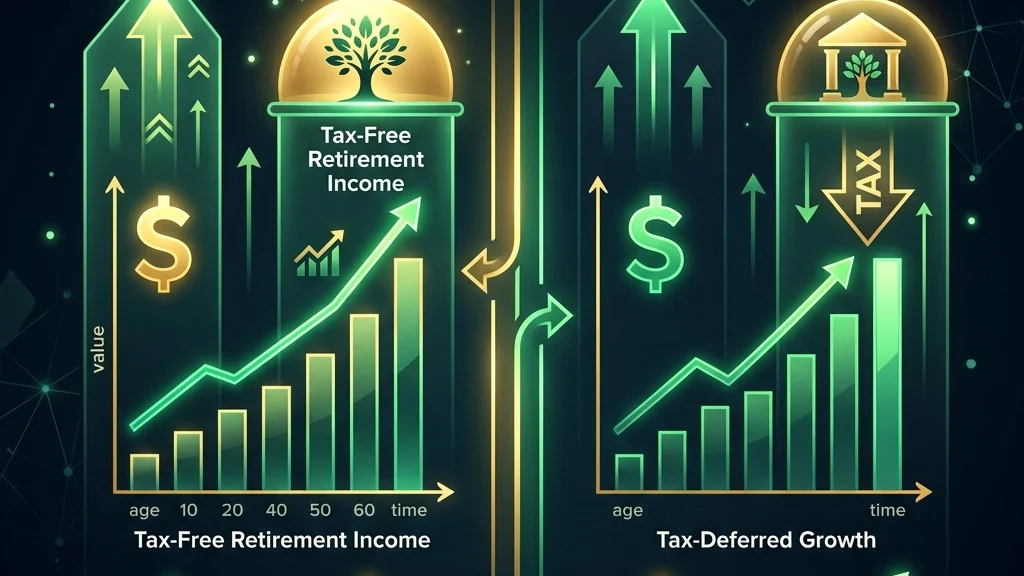
The fundamental distinction between a Traditional and a Roth IRA boils down to the timing of your tax benefit. The choice represents a trade-off between an immediate tax break today and a completely tax-free shield in the future.
- Traditional IRA (Tax-Deferred): You contribute with pre-tax dollars. This means your contributions are typically tax-deductible in the year you make them, lowering your current taxable income. The money inside the account grows tax-deferred. However, when you retire and begin withdrawing funds, every dollar you withdraw is taxed as ordinary income at your future tax rate.
- Roth IRA (Tax-Free): You contribute with post-tax dollars. You receive no immediate tax deduction today, meaning your taxable income remains the same. However, the funds grow completely tax-free, and most importantly, your withdrawals in retirement (both principal and compound earnings) are 100% tax-free.
2026 Contribution Limits and phase-Out Thresholds
For the tax year 2026, the Internal Revenue Service (IRS) maintains strict contribution limits for both Traditional and Roth IRAs. Knowing these thresholds is critical to avoiding over-contribution penalties.
The base contribution limit for 2026 is $7,000 for individuals under the age of 50. For investors aged 50 and older, a "catch-up" contribution of $1,000 is permitted, bringing their total annual limit to $8,000. Note that this limit is shared across both types of accounts; you cannot contribute $7,000 to a Traditional IRA and another $7,000 to a Roth IRA in the same year.
Traditional IRA Deduction Phase-Out Limits (2026)
If you or your spouse have access to an employer-sponsored retirement plan (like a 401k), your ability to deduct Traditional IRA contributions is phased out based on your Modified Adjusted Gross Income (MAGI):
| Filing Status | Full Deduction MAGI | Partial Deduction MAGI | No Deduction MAGI |
|---|---|---|---|
| Single | Below $77,000 | $77,000 to $87,000 | Above $87,000 |
| Married Filing Jointly | Below $123,000 | $123,000 to $143,000 | Above $143,000 |
Roth IRA Direct Contribution Phase-Out Limits (2026)
Unlike Traditional IRAs, high earners are completely restricted from contributing directly to a Roth IRA. The eligibility to make direct contributions phases out as follows:
| Filing Status | Full Contribution MAGI | Partial Contribution MAGI | No Direct Contribution |
|---|---|---|---|
| Single / Head of Household | Below $150,000 | $150,000 to $165,000 | Above $165,000 |
| Married Filing Jointly | Below $236,000 | $236,000 to $246,000 | Above $246,000 |
The Tax Bracket Strategy: Play the Long Game
The primary decision matrix for choosing between a Roth and a Traditional IRA hinges on a simple comparative question: Will my tax rate be higher or lower in retirement than it is right now?
When the Traditional IRA Wins
If you are currently in your peak earning years and find yourself in a high marginal tax bracket (e.g., 24%, 32%, or higher), a Traditional IRA is often the superior choice. By taking the deduction today, you save a significant amount of money on your current tax bill. When you retire, you will likely be earning less, dropping you into a lower tax bracket. Consequently, you will pay a much lower tax rate on your withdrawals than the tax rate you avoided during your working years.
When the Roth IRA Wins
If you are early in your career, working in an entry-level position, or currently find yourself in a lower tax bracket (e.g., 10% or 12%), the Roth IRA is a clear winner. Since your current tax burden is low, giving up the tax deduction today hurts very little. Instead, you secure a lifetime shield against taxes, allowing decades of compounding growth to build into a massive, tax-free fortune that you can withdraw entirely tax-free in retirement.
Advanced Wealth Play: The Backdoor Roth IRA Strategy
What happens if your income exceeds the direct contribution limits for a Roth IRA (above $165,000 for singles or $246,000 for married couples)? Does that mean you are shut out of the benefits of tax-free growth? Absolutely not. Wealthy investors utilize a perfectly legal loophole known as the Backdoor Roth IRA.
Here is a step-by-step breakdown of how the Backdoor Roth IRA works in 2026:
- Open a Traditional IRA: Open a Traditional IRA at a major brokerage firm (such as Vanguard, Fidelity, or Charles Schwab).
- Make a Non-Deductible Contribution: Fund the Traditional IRA with post-tax dollars up to the annual limit ($7,000 or $8,000). Since your income is high, you will not qualify for a tax deduction, making this a "non-deductible" contribution.
- Keep it in Cash: Do not buy stocks or mutual funds yet. Keep the contribution in cash or a stable money market fund to avoid any market gains or losses during the brief processing period.
- Request a Roth Conversion: As soon as the funds clear, initiate a "Roth Conversion" through your brokerage portal. You are converting your Traditional IRA into a Roth IRA. Because you did not take a tax deduction on the contribution, the conversion of the principal amount is completely tax-free.
- Invest the Capital: Once the money is safely nestled in your Roth IRA, invest it into your long-term portfolio (e.g., S&P 500 index funds, dividend stocks, or growth ETFs) to let the tax-free compound machine go to work.
Crucial Warning: The Pro-Rata Rule
The Backdoor Roth IRA strategy works perfectly only if you have zero other pre-tax IRAs (including Rollover IRAs, SEP IRAs, or SIMPLE IRAs). Under the IRS "Pro-Rata Rule," if you convert any money to a Roth IRA, the IRS looks at all your IRAs combined. If you have pre-tax money in other IRAs, your conversion will be taxed proportionally, leading to an unexpected tax bill.
Required Minimum Distributions (RMDs)
Another major structural difference between the two accounts is how the government forces you to withdraw your money in your twilight years.
- Traditional IRA: The IRS wants its tax money eventually. Therefore, Traditional IRAs are subject to Required Minimum Distributions (RMDs) starting at age 73 (or 75, depending on birth year). You are legally forced to withdraw a specific percentage of your account each year and pay taxes on it, regardless of whether you need the money.
- Roth IRA: Because Roth IRAs are built with post-tax money, there are no RMDs during your lifetime. You can leave the money in the account to compound indefinitely, or pass the entire tax-free account to your heirs, making it a spectacular tool for generational wealth transfer.
Actionable Side-by-Side Comparison
To summarize, let's look at how these two wealth vehicles stack up against each other:
| Feature | Traditional IRA | Roth IRA |
|---|---|---|
| Tax Benefit Today | Yes (Tax deduction if within MAGI limits) | No (Contributions made with post-tax dollars) |
| Tax on Growth | Tax-deferred (No tax until withdrawal) | 100% Tax-Free |
| Tax on Withdrawals | Taxed as ordinary income | 100% Tax-Free (Qualified withdrawals) |
| Income Limits | None for contributions (only for deductions) | Yes (Fully phased out above $165k Single / $246k Joint) |
| RMDs | Yes (Required starting at age 73+) | No (None during the owner's lifetime) |
| Early Penalty Exemptions | Highly restricted | Contributions can be withdrawn at any time penalty-free |
Conclusion: Crafting Your Perfect Retirement Strategy
There is no single "correct" choice in the Roth vs. Traditional IRA debate. In fact, for many middle-to-high-income earners, the best strategy is often tax diversification. By utilizing a pre-tax 401(k) at work to lower current taxes and funding a Roth IRA (either directly or via the backdoor) to secure tax-free income, you create optimal flexibility for your retirement years.
Assess your current income, calculate your 2026 tax bracket, and put your money to work today. The power of compounding rewards those who start early, and optimizing your tax structure ensures that the wealth you build remains yours to keep.
☕ Support Our Work
If you found this financial analysis valuable, you can support our independent research by sending a tip in USDT (TRC-20) to our secure cold storage address.