The digital asset landscape has undergone a seismic shift over the last decade. As we navigate through 2026, cryptocurrencies, Non-Fungible Tokens (NFTs), Real World Assets (RWAs), and decentralized autonomous organization (DAO) tokens have become integral parts of global institutional and retail portfolios. However, with the exponential rise in the value and utility of digital assets comes a highly sophisticated evolution in cyber threats. From AI-driven, hyper-personalized phishing attacks to the looming shadow of quantum-computing-resistant exploits, the stakes for securing your private keys have never been higher.
In this high-stakes environment, the fundamental ethos of the cypherpunk movement—“Not your keys, not your coins”—remains the golden rule of crypto wealth management. While software wallets (hot wallets) offer unparalleled convenience for daily decentralized finance (DeFi) interactions, hardware wallets—often referred to as “cold storage”—remain the absolute industry standard for long-term security. In this comprehensive guide, we analyze the top 5 hardware wallets of 2026, evaluating them based on their physical security architecture, user interface, multi-chain support, open-source principles, and future-proof features.
1. Why Hardware Wallets are Absolutely Non-Negotiable in 2026
Before diving into our top hardware picks, it is essential to understand the current technological threat model. In 2026, centralized exchanges (CEXs), despite massive increases in regulatory oversight and insurance funds, are still prime targets for multi-million dollar breaches. Furthermore, “hot wallets” (applications installed on your mobile phone or desktop browser) are intrinsically vulnerable to zero-day exploits in operating systems, malicious smart contract approvals, and clipboard-hijacking malware.
The Air-Gap Principle
A hardware wallet’s primary and most critical job is to ensure your private keys never touch an internet-connected device. By signing cryptographic transactions locally on the device's internal microchip, the sensitive data (your seed phrase) is physically and digitally isolated from the “hot” environment of your computer or smartphone. The only data that travels through the USB cable or Bluetooth connection is the mathematically signed, finalized transaction, which is completely useless to a hacker without the device itself.
Biometric Integration and Post-Quantum Security
Leading hardware wallets in 2026 have pushed the boundaries by integrating biometric authentication (such as highly secure fingerprint sensors or iris scanning) and post-quantum cryptographic algorithms. These advancements ensure that even as global computing power grows exponentially, and quantum computers become capable of breaking traditional RSA encryption, your digital assets remain mathematically unreachable by unauthorized third parties.
2. Ledger Stax Pro: The King of Connectivity and Aesthetics
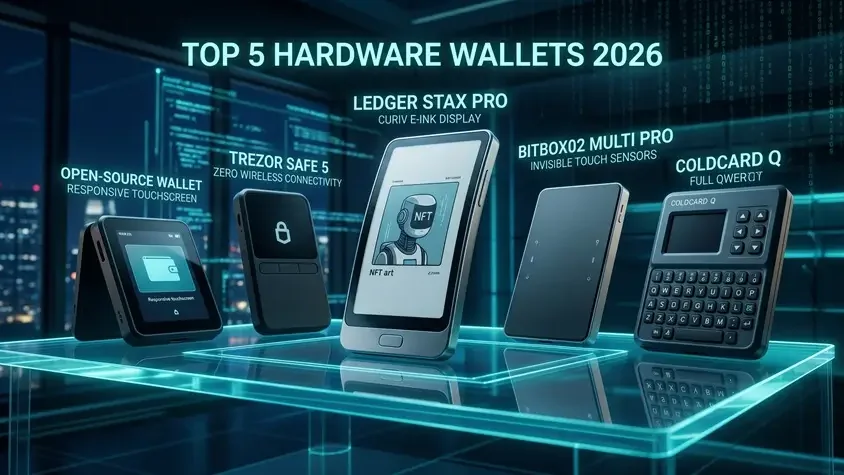
Ledger has long been the dominant, mainstream force in the hardware wallet industry, and the Ledger Stax Pro is their most ambitious and visually stunning release to date. Building on the foundation of the original Stax designed by Tony Fadell, the Pro version focuses heavily on the high-end retail user, DeFi power user, and serious NFT collector.
Design and Display
The Stax Pro features a revolutionary, curved, high-resolution E-Ink display that wraps around the spine of the device. This allows users to view transaction details with crystal clarity and even display their favorite digital art or NFT as an “always-on” locked screen.
Key Features:
- Secure Element (SE): Utilizes the latest EAL6+ certified chip, which is the exact same standard used in biometric passports and high-end bank cards.
- Bluetooth 5.3 & NFC: Seamlessly and securely connects to the Ledger Live mobile app with military-grade encrypted, low-latency communication.
- Wireless Charging: Supports Qi-standard charging, entirely eliminating the need for carrying cumbersome cables.
- NFT Native Support: Direct, on-screen visualization of metadata for ERC-721, ERC-1155, and modern dynamic NFTs, preventing blind-signing attacks.
3. Trezor Safe 5: The Open-Source Gold Standard
Trezor’s core philosophy has always been built around absolute transparency. The Trezor Safe 5, released in late 2025, proudly continues this tradition by offering a fully open-source hardware and software stack. This allows the global cybersecurity community to continuously audit every single line of code, ensuring no hidden backdoors exist.
Security through Transparency
While other companies use proprietary, closed-source “Secure Elements” (which require trusting the manufacturer), Trezor uses a specialized chip architecture that achieves robust security without sacrificing open-source principles, passing rigorous physical penetration testing.
Key Features:
- Trezor Suite Integration: A robust, privacy-focused desktop and mobile application that includes built-in CoinJoin for Bitcoin transaction privacy and native Tor network integration.
- Shamir Backup: A revolutionary security feature that allows users to split their 24-word recovery seed into multiple shares (e.g., a 3-of-5 setup). This significantly reduces the risk of a single point of failure; if a thief finds one share, your funds remain safe.
- Haptic Touchscreen: A vibrant, responsive screen that provides physical feedback, making entering PINs and verifying long hexadecimal addresses intuitive.
- Bitcoin-Only Firmware: For the ultimate maximalists, Trezor offers a dedicated version of the firmware that strips out all altcoin and smart contract code, drastically minimizing the potential attack surface.
4. Ngrave Zero 2: The “Perfect” Air-Gap Fortress
If Ledger is about seamless connectivity and Trezor is about radical transparency, Ngrave is strictly about uncompromising isolation. The Ngrave Zero 2 is widely considered by institutional custodians as the most secure hardware wallet on the consumer market because it has absolutely zero physical or wireless connection capabilities.
No WiFi, No Bluetooth, No USB
The Ngrave Zero 2 interacts with the outside world exclusively through QR codes. You scan an unsigned transaction request from your phone's camera, visually review and sign it on the Zero 2’s offline touchscreen, and then scan the resulting signed QR code back into your phone to broadcast it to the blockchain.
Key Features:
- EAL7 Security Certification: Currently the only consumer-grade wallet in the world aiming for and achieving the highest possible security evaluation level (EAL7).
- Anti-Tamper Design: The device is built with a rugged, military-grade casing. It is virtually impossible to open without triggering an internal mechanism that instantly wipes all data, destroying the internal chips.
- Perfect Key Generation: Uses an ingenious combination of your live biometric data, ambient light sensors, and internal true random number generators (TRNG) to create a seed phrase that is vastly more random and secure than standard computer-generated ones.
5. BitBox02 Multi Pro: Swiss Precision for the Power User
Produced by Shift Crypto in Switzerland, the BitBox02 Multi Pro is heavily favored by those who want a minimalist, highly efficient, and deeply secure device. It is frequently cited as the “developer’s favorite” due to its impeccably clean codebase and straightforward user experience.
The Dual-Chip Architecture
The BitBox02 utilizes a highly unique approach: it combines a fully open-source microcontroller for the main operational logic with a separate, hardened secure element solely to store the encrypted seed. This “best of both worlds” approach provides extreme physical security while maintaining software auditability.
Key Features:
- MicroSD Backup: Instead of writing down 24 words on paper, you can save your backup directly to an encrypted MicroSD card in seconds, allowing for secure digital redundancy.
- In-App Staking: Direct, secure integration with Liquid Staking Derivatives (LSDs) for assets like Ethereum (ETH) and Solana (SOL) directly from the cold storage interface.
- Invisible Touch Sensors: There are no physical buttons that can break over time. The device uses advanced touch sensors along its edges, making it incredibly sleek, durable, and discreet.
6. ColdCard Q: The Bitcoin Maximalist’s Dream
For purists who only care about Bitcoin and nothing else, the ColdCard Q from Coinkite is the undisputed heavy champion. It looks like a retro, high-end calculator from the 90s, but beneath its plastic shell, it is packed with every advanced Bitcoin-specific security feature imaginable.
Advanced Features for Experts:
- Full QWERTY Keyboard: Entering complex passphrases and PINs is incredibly fast and secure compared to scrolling through letters on a small screen.
- Dual MicroSD Slots: Enables complex, enterprise-grade multi-signature (multisig) setups and completely air-gapped firmware updates.
- “Brick Me” PIN: A special, decoy code. If you are physically threatened (a $5 wrench attack) and forced to enter a PIN, entering this specific code physically and permanently destroys the internal secure element, locking the attackers out forever.
- BIP-85 Support: Allows you to derive multiple, entirely separate child-seeds from one single master seed, letting you manage dozens of different wallets from a single device backup.
7. Comparative Analysis Table (2026 Overview)
| Feature | Ledger Stax Pro | Trezor Safe 5 | Ngrave Zero 2 | BitBox02 Multi | ColdCard Q |
|---|---|---|---|---|---|
| Security Chip | SE (EAL6+) | Proprietary Open | SE (EAL7) | Dual Chip Architecture | SE (EAL6+) |
| Connectivity | Bluetooth, NFC, USB-C | USB-C | QR Codes (100% Air-gapped) | USB-C | USB-C, NFC |
| Open Source | Partial (Apps open, SE closed) | Fully Open | Partial | Fully Open | Fully Open |
| Screen Type | Curved E-Ink Display | LCD Color Touchscreen | Large LCD Touchscreen | Invisible OLED | B&W LCD |
| Best For | NFT Collectors / Multi-chain | General Users / Privacy | Ultra High-Security Holders | Power Users / Minimalists | Bitcoin Maximalists Only |
8. Critical Security Practices in 2026
Owning the best hardware wallet in the world is only half the battle. How you utilize and store it determines your actual, real-world level of safety.
- Verification is Everything: Always, without exception, verify the recipient address and the transaction amount directly on the hardware wallet’s physical screen. Malicious software on your computer can easily alter the address displayed in your browser. The screen on your hardware device is your only “Source of Truth.”
- The Passphrase (The 25th Word): Adding a custom passphrase (BIP39) creates a completely “hidden” wallet. Even if a thief manages to steal your physical 24-word seed phrase paper, they cannot access your funds without this additional secret word, which should be stored in a completely separate physical location.
- Physical Protection of the Seed: In 2026, physical theft and environmental damage are rising concerns. Do not rely on paper. Use a solid titanium or stainless steel seed storage plate (like Cryptosteel or Billfodl) to protect your ultimate backup from house fires, water damage, and severe corrosion. Never, under any circumstances, store your seed phrase in a digital format (no photos, no password managers, no encrypted cloud drives).
Conclusion
Securing your generational wealth in 2026 requires a highly proactive approach. The Ledger Stax Pro offers the absolute best user experience and visual appeal, while the Ngrave Zero 2 provides the ultimate, impenetrable fortress for those with large institutional-sized holdings. Trezor remains the undisputed champion of open-source cypherpunk values, BitBox offers unmatched Swiss efficiency, and ColdCard is the ultimate bunker for hardcore Bitcoin enthusiasts.
Regardless of which cutting-edge device you choose, remember that the most critical link in the security chain is you. Keep your seed phrase physical, utilize a strong 25th-word passphrase, and never trust a digital computer screen over your hardware wallet’s display.
Disclaimer: This comprehensive article is for educational and informational purposes only and does not constitute financial or security advice. Always perform your own rigorous due diligence before purchasing and setting up security hardware.
Frequently Asked Questions (FAQ)
Q1: Is Bluetooth in hardware wallets safe?
Yes. In devices like the Ledger Stax Pro, the Bluetooth connection is heavily encrypted. Even if an attacker manages to intercept the Bluetooth signal, your private keys never leave the Secure Element chip. The only thing sent via Bluetooth is the public, unsigned data for the transaction, which you must still physically review and approve by pressing buttons on the device.
Q2: Can I lose my coins if the hardware wallet company goes bankrupt?
No, absolutely not. Your coins do not live inside the device or on the company's servers; they live on the decentralized blockchain. As long as you possess your 24-word recovery seed (and your optional passphrase), you can seamlessly restore your entire wallet and access your funds on any other BIP39-compatible hardware or software wallet from a different manufacturer.
Q3: Do I need a different hardware wallet for each cryptocurrency?
In 2026, most top-tier multi-chain wallets (Ledger, Trezor, BitBox) support thousands of different tokens across dozens of networks (Ethereum, Solana, Bitcoin, Polkadot, L2s, etc.) simultaneously. However, specialized wallets like the ColdCard explicitly only support Bitcoin. They do this to completely remove altcoin codebases, which minimizes the software's attack surface and maximizes security for Bitcoin.
Q4: How often should I update the firmware on my hardware wallet?
You should update your firmware whenever the official desktop or mobile app notifies you of a critical security release. These updates often include essential patches for newly discovered vulnerabilities, as well as support for new blockchain features. However, always ensure you have physical access to your 24-word recovery seed before initiating an update, as interrupted updates can sometimes reset the device to factory settings.
Q5: Can a hardware wallet actually be hacked?
While no electronic system is 100% theoretically unhackable, hardware wallets are specifically designed to make remote, digital hacking virtually impossible. Almost all successful “hacks” involving hardware wallets are actually social engineering or phishing attacks, where the user is tricked into typing their 24-word seed phrase into a fake website or giving it to a scammer.
Secure Your Assets with Ledger
Centralized exchanges and hot wallets are vulnerable to online threats. Keep your private keys physically isolated on a Ledger hardware wallet. Buy directly from the official store using our partner link to ensure device authenticity.
Get Your Ledger Securely →☕ Support Our Work
If you found this financial analysis valuable, you can support our independent research by sending a tip in USDT (TRC-20) to our secure cold storage address.