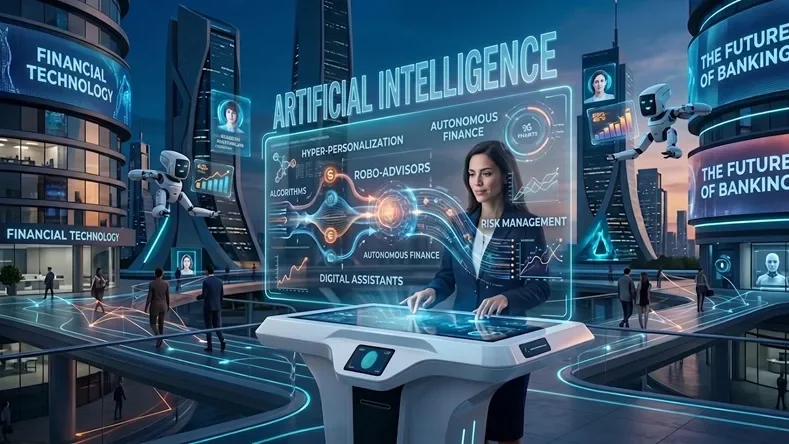
The financial world is experiencing one of the greatest technological revolutions in its history. The traditional approach to banking—characterized by long queues, rigid credit scoring, and generic investment advice—is rapidly giving way to a data-driven, predictive, and highly personalized digital ecosystem. At the heart of this massive paradigm shift is Artificial Intelligence (AI) and its powerful sub-branches: Machine Learning (ML), Deep Learning, and Natural Language Processing (NLP).
Today, banks and financial institutions are no longer just secure vaults where we store our money; they are actively transforming into intelligent digital life partners. These advanced systems manage our financial health in real-time, predict potential economic risks before they materialize, and develop highly personalized wealth accumulation strategies for every single individual. We are entering an era where algorithms understand our financial needs better than we do.
1. Personalization and Customer Experience in Retail Banking
In traditional retail banking, “customer segmentation” simply meant grouping thousands of people based solely on their age bracket or monthly income level. However, AI has made the ultimate “N=1” strategy a reality—treating every single customer as a unique, dynamic segment of their own.
Hyper-Personalized Financial Offers and Predictive Banking
Modern AI algorithms analyze an astonishing amount of data. They look not only at a user’s basic banking transactions but also analyze spending locations, shopping frequency, travel habits, and even digital footprints via Open Banking APIs. For example, if a user frequently shops at hardware stores and browses furniture online, the AI interprets this as a strong “home renovation” signal. Instead of sending a generic newsletter, the bank’s app immediately pushes a notification offering a tailored home improvement loan with preferential rates at that exact moment. This is the epitome of delivering the right offer, to the right person, at the absolute right time.
Next-Generation Conversational Banking
NLP-based chatbots and virtual assistants have evolved far beyond answering simple “What is my current balance?” queries. Modern AI assistants, powered by Large Language Models (LLMs), possess deep context-awareness and historical memory. If you ask your banking app, “How much did I spend on dining out last month compared to my usual average?”, it doesn’t just output a raw number. It generates visual graphs, compares it to your localized peer group, and highlights exactly what percentage of your budget this represents. It might even suggest actionable advice: "If you reduce dining out by 15% this month, you will hit your emergency fund goal three weeks early."
2. Algorithmic Transformation and Robo-Advisory
Historically, sophisticated wealth management, tax optimization, and bespoke portfolio construction were exclusive domains reserved strictly for “Ultra High Net Worth” (UHNW) individuals who could afford expensive human wealth managers. Artificial intelligence has fundamentally shattered this barrier, democratizing institutional-grade wealth management for the everyday retail investor.
How Modern Robo-Advisors Work
Robo-advisors initiate the process by presenting the investor with a psychometric and financial questionnaire to assess risk tolerance, investment horizon, age, and retirement goals. Using principles from Modern Portfolio Theory (MPT), the AI then scans thousands of stocks, Exchange Traded Funds (ETFs), bonds, commodities, and even crypto assets across global markets. The algorithm mathematically calculates thousands of potential combinations in milliseconds to build the ideal portfolio that minimizes total downside risk while maximizing expected returns (the Efficient Frontier).
Tax-Loss Harvesting and Automatic Rebalancing
One of the most sophisticated strategies used by Wall Street portfolio managers is “Tax-Loss Harvesting.” Today, this complex process is fully automated by AI for accounts holding as little as $500. The algorithmic system strategically identifies and sells depreciated assets at a loss to offset capital gains taxes, immediately replacing them with similar (but not identical) assets to maintain the portfolio's target allocation. Furthermore, when market volatility distorts the original asset allocation (e.g., tech stocks surge, making the portfolio too risky), the AI automatically rebalances the assets back to their target weights without requiring any human intervention.
3. Financial Psychology and Behavioral Economics
One of the least discussed but arguably most effective applications of AI in wealth management is Behavioral Finance. Humans are naturally emotional creatures who often succumb to psychological biases—specifically fear and greed—when making critical financial decisions.
- Sentiment Analysis and Panic Prevention: During severe market crashes or extreme volatility, AI continuously analyzes a user’s login frequency and trading patterns. If the system detects erratic behavior or a sudden urge for “panic selling,” the digital advisor intervenes. It might pause the transaction screen with a calming, data-backed notification showing historical recovery charts, effectively saving the investor from locking in a temporary loss.
- The Nudging Theory: Behavioral AI actively improves daily spending habits through micro-interventions. By sending small, perfectly timed push notifications like, “You are about to spend $6 on coffee. If you invest this $6 today, based on an 8% average return, it could be worth $45 in your retirement account,” the AI gently “nudges” the user toward better long-term financial health.
4. Technical Architecture: How Financial AI Operates
The incredible capabilities of Financial AI are supported by a massive, highly secure cloud-based architecture. This architecture typically consists of four main layers:
- The Data Lake: This is the foundation. It aggregates structured internal bank data, unstructured data (like global financial news, Twitter sentiment, and earnings call transcripts), and alternative data (such as satellite imagery of retail parking lots or global shipping logistics data).
- Feature Engineering and Processing: In this layer, raw, chaotic data is refined and converted into actionable “financial signals” (e.g., momentum indicators, volatility metrics, and dynamic credit score inputs).
- The Model Layer: This is the brain. It utilizes advanced algorithms like Random Forests for classification, Gradient Boosting for risk assessment, and LSTM (Long Short-Term Memory) neural networks for highly accurate time-series forecasting and stock price modeling.
- The Application Layer (API): Utilizing microservices architecture, this layer securely and rapidly delivers the AI’s complex calculations directly to the user interface on your mobile banking app.
5. Advanced Risk Management and Cybersecurity
As finance becomes entirely digital, the attack surface for malicious actors expands. AI is the only defense mechanism capable of operating at the required speed and scale.
Credit Scoring with Alternative Data
Traditional credit bureaus rely on archaic scoring systems that often marginalize the unbanked or younger demographics. AI models revolutionize this by using “alternative data” to measure real creditworthiness. Consistency in utility payments, stability indicated on professional networks like LinkedIn, digital wallet usage, and even e-commerce return rates are now synthesized by ML algorithms to grant micro-loans to people who were previously invisible to the banking system.
Real-Time Fraud Detection via Behavioral Biometrics
Legacy security systems operated on rigid, easily bypassed fixed rules. Modern AI, however, utilizes “behavioral biometrics.” The AI learns exactly how you interact with your device: the specific angle you hold your phone, how hard you press the screen, your typing cadence, and how fast you scroll. This creates a unique digital “identity.” If a transaction is initiated with correct passwords but from an unusual device angle or typing speed, the AI flags it as a potential account takeover and instantly blocks the transaction.
6. Generative AI (GenAI) and the Era of Autonomous Finance
The explosive rise of Generative AI models (like OpenAI's GPT series) is actively shifting banking from a “transaction-centric” model to a “dialogue-centric” one.
The Future Scenario: Complete Autonomous Finance
In the near future, “Autonomous Finance” will become the global standard. You will grant your AI agent fiduciary duty to make decisions on your behalf. Imagine waking up to a notification:
“Since this month’s electricity bill was $40 higher than your historical average, I automatically shifted $40 from your low-yield checking account to cover it, paused your weekly ETF investment to maintain cash flow, and activated a 5% grocery cashback campaign on your credit card to offset the loss.”
This unprecedented level of automation aims to reduce individual financial stress and cognitive load to absolute zero.
7. Global Application Examples from Industry Giants
How are the world's largest financial institutions utilizing this technology today?
- JPMorgan Chase: Their proprietary “COiN” (Contract Intelligence) software utilizes machine learning to review complex commercial credit agreements in seconds—a tedious task that previously consumed over 360,000 hours of highly-paid lawyers’ time annually.
- Ant Group (Alipay): They revolutionized global micro-lending with their famous “3-1-0” model: It takes 3 minutes to apply on a smartphone, 1 second for the AI to approve the loan using thousands of data points, and involves 0 human intervention.
- HSBC and Google Cloud: HSBC leverages Google Cloud’s advanced Anti-Money Laundering (AML) AI to detect sophisticated financial crimes, reducing the rate of false positive alerts by an incredible 20%, saving millions in compliance costs.
Conclusion: The New Architect of Finance
Artificial intelligence is not just digitizing the surface layer of retail banking; it is fundamentally rewiring the core mechanics of how money moves, grows, and is protected. Wealth management is no longer a walled garden reserved for the ultra-rich; it has become a highly democratized standard available to absolutely anyone with an internet connection and a smartphone.
The ultimate winners in this historic financial transformation will be the investors and consumers who view AI technology not as a dystopian threat, but as the strongest possible leverage on the path to financial freedom. In the financial world of tomorrow, the archaic question of “Where is my money?” will be entirely replaced by a new, more powerful question: “What is my AI planning for me today?”
Frequently Asked Questions (FAQ)
Q1: Can AI make catastrophic mistakes while managing my money?
A: While AI models are incredibly powerful, they rely on historical data and statistical probabilities. In unprecedented, extreme market events (often called "Black Swan" events like sudden wars or global pandemics), models can temporarily miscalculate risks. Because of this, professional institutional systems always operate on a “Human-in-the-loop” principle, where human experts oversee the AI's macro decisions during extreme volatility.
Q2: How much capital do I need to start using AI robo-advisors?
A: One of the greatest benefits of AI in finance is democratization. While traditional private wealth management often requires a minimum of $1,000,000 in liquid assets, most modern AI-driven robo-advisors offer professional-grade portfolio management and tax-loss harvesting for nominal amounts, sometimes as low as $10 or $50 to start.
Q3: With AI analyzing all my spending, how is my data privacy protected?
A: Top-tier financial institutions use advanced cryptographic techniques like “Differential Privacy” and “Homomorphic Encryption.” These cutting-edge methods allow the AI algorithms to analyze your financial behaviors and train their predictive models while your actual personal data remains completely encrypted. The AI learns the patterns without ever actually “seeing” your personal identity.
Q4: Will AI in banking cause human financial advisors to lose their jobs?
A: AI is guaranteed to take over repetitive, technical, and data-heavy tasks such as initial portfolio balancing and document verification. However, human advisors are not disappearing; they are evolving. Complex financial advisory involving estate planning, family dynamics, situations requiring deep human empathy, and nuanced ethical decision-making will always require human expertise. The future is humans augmented by AI, not replaced by it.
☕ Support Our Work
If you found this financial analysis valuable, you can support our independent research by sending a tip in USDT (TRC-20) to our secure cold storage address.